


India’s New Industries Need a Talent Revolution
India is building factories, data centres, solar parks, logistics hubs and advanced manufacturing clusters at a pace that would have seemed ambitious a decade ago. The machines are arriving. The land is being prepared. The power lines, warehouses and production lines are taking shape.
The harder question is quieter, but just as urgent.
Who will run all of it?
A factory does not operate because the building is ready. A data centre does not stay online because servers have been installed. A renewable-energy project does not deliver reliable power because panels and turbines exist. Each new industry needs people who can design, install, maintain, troubleshoot and improve complex systems.
That is why India’s new industries need a talent revolution. The next phase of growth will depend not only on capital investment, but on whether the country can build the talent infrastructure to match its physical infrastructure.
Industrial expansion is already creating jobs
India’s manufacturing push is no longer just a policy ambition. It is showing up in investment and employment numbers.
The Production Linked Incentive schemes offer one clear view of this shift. According to the Government of India, the 14 PLI schemes had attracted more than ₹2.40 lakh crore in actual investment by March 2026. They also reported employment generation of more than 14.15 lakh, including direct and indirect jobs.
The sector-level numbers show how broad this job creation can be. Under the PLI programme, large-scale electronics manufacturing had reported 1,69,249 cumulative employment. Food products reported 3,29,200. Pharmaceuticals reported 1,14,880. Automobiles and auto components reported 67,820 as of March 2026.
These figures point to a larger truth. Industrial investment does not create only one type of job. It creates an employment ecosystem.
Around every major facility, there are roles in:
Production and assembly
Quality testing
Equipment maintenance
Plant operations
Procurement and inventory
Safety and compliance
Logistics and warehousing
Vendor management
Energy management
Data and automation support
A manufacturing unit may begin with machines, but it grows through people who understand process, discipline and problem-solving. The same is true for newer sectors such as semiconductors, green hydrogen, battery storage, data centres and high-tech logistics.
The employment opportunity is real. The risk is that the skill supply may not keep pace with the opportunity.
New industries need new combinations of skills
India has long produced engineers, technicians and graduates at scale. Yet the talent challenge in emerging industries is not only about the number of people available. It is about whether their skills match the work that is being created.
Many of the new jobs sit between traditional categories.
A data-centre technician, for example, may need to understand electrical systems, cooling infrastructure, network uptime, safety protocols and incident response. A renewable-energy project professional may move between site planning, grid connection, vendor coordination, equipment monitoring and field operations. A semiconductor facility may need workers who can follow strict process controls, work in cleanroom conditions and handle specialised equipment with high precision.
These are not always jobs that can be filled by generic degrees alone. They often require a mix of:
Technical knowledge
Hands-on practice
Safety awareness
Digital fluency
Process discipline
Team coordination
Continuous learning
This shift matters because India’s new industrial base is not built only around low-cost labour. It is becoming more technology-driven. Factories use sensors, automation, robotics and data systems. Warehouses use scanning tools, route planning software and real-time tracking. Energy assets use monitoring platforms and predictive maintenance. Even traditional roles now demand digital comfort.
The future technician may need to read a dashboard as confidently as a wiring diagram. The future plant supervisor may need to understand both people management and machine data. The future logistics professional may need to handle both warehouse realities and software systems.
That changes how India must think about talent.
The skills gap can slow down physical growth
Infrastructure delays are easy to see. A road is incomplete. A plant is not ready. A grid connection is pending. Talent gaps are harder to see at first, but they can slow growth just as much.
A company may build a facility and still struggle to staff specialised roles. It may hire quickly, then spend months retraining employees. It may bring in experienced workers from other regions because local talent is not ready. It may face higher downtime because maintenance skills are weak. It may struggle with quality because workers have not been trained for the tolerances required.
These challenges do not always make headlines, but they affect output every day.
A talent shortage can lead to:
Slower project ramp-up
Higher operating costs
More dependence on a small pool of experienced workers
Lower productivity
Higher attrition in critical roles
Missed export or delivery targets
This is especially important for industries where reliability matters. Data centres cannot afford frequent failure. Semiconductor manufacturing requires exacting standards. Renewable-energy operators must maintain assets across wide geographies. Automotive and electronics manufacturers must meet strict quality and delivery timelines.
When skills lag, investment does not deliver its full value.
Talent creation has to move closer to industry
India does not need skills training in the abstract. It needs training that connects directly to the jobs being created.
That means stronger links between industry, training institutions, state governments and local employers. A training programme for electronics manufacturing should not look like a generic classroom course. It should expose learners to production flow, quality checks, electrostatic safety, machine handling and shift discipline. A course for renewable energy should include site exposure, equipment basics, safety drills and maintenance routines.
The best training models are usually built around real work.
They include:
Practical labs that mirror industry equipment
Apprenticeships and paid trainee roles
Short courses for workers who need to upgrade
Certification tied to specific job roles
Local training centres near industrial clusters
Instructor development, so trainers stay current
Employer feedback on curriculum and performance
This matters because many roles in new industries do not require every worker to hold an advanced degree. They require job-ready competence. India needs many more pathways where a young person can move from school, ITI, polytechnic or college into a skilled industrial role with clear earning potential.
That path must also support workers already in the labour force. A warehouse worker may learn inventory software. An electrician may train for solar operations. A mechanical technician may learn automation maintenance. A diploma holder may move into data-centre infrastructure support.
The talent revolution will not be built only by producing new graduates. It will also come from helping existing workers climb into better roles.
Regional training will shape regional growth
India’s new industries are not appearing in only one city. Electronics clusters, automotive hubs, renewable-energy parks, logistics corridors and data-centre zones are spreading across states.
That makes regional talent planning essential.
If a state attracts manufacturing investment but does not build a local skills pipeline, employers may have to import talent from elsewhere. That can work in the short term, but it raises costs and limits local job creation. If local youth do not see a path into new industries, the benefits of investment remain uneven.
A stronger approach would connect industrial policy with local workforce planning.
When a region attracts a major investment, the talent questions should begin early:
What job roles will the project create during construction?
What roles will remain during operations?
Which roles need diploma, ITI, graduate or postgraduate talent?
Which skills can be taught locally within six months?
Which skills need longer technical preparation?
Which training institutions can be upgraded nearby?
How can women, rural youth and first-generation workers access these jobs?
This is where India can turn industrial growth into broad employment. If training centres, colleges and employers work together near emerging clusters, local communities gain a real stake in new industries.
The talent challenge is also a retention challenge
Hiring is only the first step. New industries must also retain people.
Many technical workers leave jobs because the career path is unclear. Some move because training is limited. Others leave because wages do not grow with skill. In sectors with hard shifts, remote sites or high-pressure operations, retention becomes even harder.
Companies that treat talent only as a hiring problem will struggle. They need to build internal systems that help people stay and grow.
That includes:
Clear role levels
Skill-based pay progression
Supervisor training
Safer working conditions
Good accommodation and transport where needed
Respect for frontline technical roles
Regular upskilling
Internal mobility across plants, sites and functions
This is not charity. It is good industrial practice. A trained maintenance technician who stays for five years carries practical knowledge that no manual can fully capture. A supervisor who understands both process and people can prevent mistakes before they become expensive. A loyal operations team can stabilise output faster than a constantly rotating workforce.
The countries that build strong manufacturing systems usually value technical careers. India will need to do the same.
Education needs to become more modular and practical
India’s education system still relies heavily on long degrees and exam performance. Those routes matter, but emerging industries also need faster, modular and practical learning options.
A worker should be able to build skills in stages. A student should be able to earn a certificate, work for a while, return for advanced training and move up. A technician should be able to add a specialisation without leaving employment for years.
This is especially useful in industries where technology changes quickly. The tools used in warehouses, factories and energy systems will keep changing. People will need to learn throughout their careers.
Short, practical modules can support this shift. For example:
Basics of industrial safety
Introduction to programmable logic controllers
Solar plant maintenance
Battery handling and safety
Data-centre cooling systems
Quality control in electronics assembly
Warehouse automation basics
Industrial Internet of Things fundamentals
These modules should not become paper credentials with little value. They need assessment, practical testing and employer recognition. A certificate must signal that a person can actually perform a task.
India needs respect for skilled technical work
One cultural issue sits at the centre of the talent question. India often places degrees above skills. Families may prefer a general degree over a strong vocational pathway, even when the vocational route offers better job prospects.
That mindset needs to change.
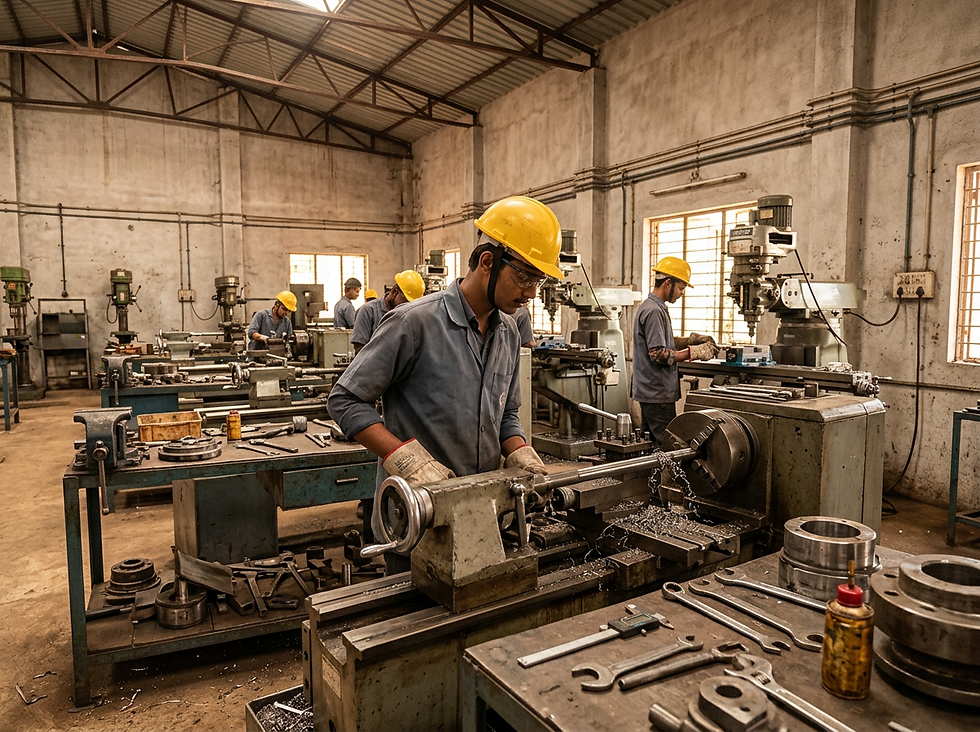
A modern economy needs engineers, scientists and managers. It also needs welders, machine operators, maintenance technicians, line supervisors, safety officers, electricians, instrument technicians, logistics coordinators and field service professionals.
These are not fallback jobs. They are the people who keep industry running.
If India wants to become a serious manufacturing and technology-led production hub, skilled technical work must carry status. Training pathways must lead to visible careers. Employers must pay for competence. Parents and students must see dignity in industrial roles. Policymakers must measure not only enrolment, but job outcomes and wage growth.
The talent revolution will succeed when a young person can say, with pride, that they are building a career in advanced manufacturing, renewable energy, data-centre operations or industrial logistics.
The next growth constraint may be people
India has made a clear bet on new industries. The investment is visible in factories, clean-energy assets, logistics networks, electronics production and advanced manufacturing plans. The employment numbers from PLI schemes already show that industrial growth can create jobs at scale.
The next task is to build the human capacity behind that growth.
This calls for action on several fronts at once:
Employers must define roles clearly and invest in training.
Training providers must teach practical, current skills.
States must link industrial planning with workforce planning.
Educational institutions must work more closely with industry.
Workers must get pathways to upgrade throughout their careers.
Society must value skilled technical work more seriously.
Physical infrastructure can be built with capital, approvals and execution. Talent infrastructure takes longer. It needs trust, coordination and repeated practice.
As new industries create demand for specialised talent, recruitment itself is also evolving. Recruiters may increasingly work across multiple sectors, hiring requirements and locations rather than relying on a single type of mandate.
For independent recruiters, this can create opportunities to work on specialised and volume hiring assignments while building experience across industries.

Freelance recruitment can offer recruiters a more flexible way to work, use their existing talent networks and take on assignments based on their expertise and availability.
For recruiters looking to explore this model, platforms such as FreelanceRecruiter.in provide an avenue to discover recruitment opportunities and work on hiring mandates across different sectors.
India’s growth story will not be decided only by how many plants are announced or how much money is invested. It will be decided by how well the country prepares people to run, maintain and improve the systems it is building.
The factories are rising. The networks are expanding. The energy projects are spreading. Now India has to make sure the workforce is ready to meet them.


Comments