


The Rise of the Always Learning Professional
A degree once acted like a passport into a long career. It proved that someone had studied the right subject, understood the basics and was ready to begin. From there, experience did most of the work.
That pattern is fading.
Careers are no longer shaped only by tenure, job titles or years spent in one role. They are increasingly shaped by a person’s ability to keep learning, adjust to new tools, understand new problems and apply fresh skills in real work. This has led to the rise of a new kind of worker: the always learning professional.
This does not mean spending every evening on online courses or chasing certificates for the sake of it. It means building the habit of staying current. Sometimes that comes through formal training. At other times, it comes from a difficult project, a mentor’s advice, a new technology, a changing regulation, an industry report or a better way of doing a familiar task.
The point is simple. Expertise is becoming less fixed. The most valuable professionals are not the ones who know everything today. They are the ones who can keep becoming useful tomorrow.
Why continuous learning now matters more than before
The speed of change at work is the main reason learning has moved from a “nice to have” habit to a core professional skill.
The World Economic Forum’s Future of Jobs Report 2025, based on the views of more than 1,000 employers across 55 economies, estimates that 39% of workers’ existing core skills could be transformed or become outdated between 2025 and 2030. The same report estimates that, if the global workforce were represented by 100 people, 59 would need training by 2030.
The message is not that people will become unemployable overnight. It is that being “qualified” is becoming more fluid.
A qualification still matters. It can open doors, build foundations and signal commitment. In fields such as engineering, finance, healthcare, law, education and technology, formal credentials remain essential.
Yet a qualification is no longer the whole story. A software developer may need to learn new AI-assisted coding tools. A teacher may need to adapt to digital learning platforms. A finance professional may need to understand data privacy, automation and changing compliance rules. A small business owner may need to track new payment systems, tax updates and customer behaviour.
The same pattern appears across sectors. Work changes, tools change and customer expectations change. The person who keeps learning can respond with more confidence.
The skills that matter are changing
Technology is the most visible part of this shift. AI, big data, cybersecurity and general technological literacy are among the fastest-growing skill areas identified by the World Economic Forum. That makes sense. Digital tools now sit inside almost every profession, from agriculture and logistics to banking, design and public services.
But the rise of technology does not reduce the value of human skills. In many roles, it increases their importance.
When tools become more powerful, people need better judgement. When information becomes easier to generate, people need better critical thinking. When teams work across locations, cultures and time zones, communication becomes harder, not easier.
The future-ready professional needs a mix of skills:
Technical awareness
Knowing enough about tools, systems and data to work well with them.
Critical thinking
Testing assumptions, checking sources and making careful decisions.
Adaptability
Staying calm when a process, role or market changes.
Communication
Explaining ideas clearly to people with different levels of knowledge.
Self-management
Planning time, energy and effort without constant supervision.
Ethical judgement
Understanding the human impact of decisions, especially when using data and AI.
This mix matters because most real work does not fit neatly into one skill category. A nurse using digital records, a civil engineer reading climate data, a retailer managing online payments or a journalist checking AI-generated information all need both technical and human judgement.
Learning is becoming part of the job itself
This shift towards practical learning is also creating opportunities for professionals to explore flexible ways of working and apply their expertise across different projects. For instance, recruitment professionals can continue developing their industry knowledge, understanding changing hiring requirements and building client relationships through freelance recruitment opportunities. Platforms such as FreelanceRecruiter.in help connect recruitment professionals with opportunities to put their skills into practice, making continuous learning a more hands-on part of their career journey. For many people, learning still sounds like a separate activity. Work happens during the day, learning happens after hours. That idea is becoming less useful.
The best learning often happens inside the work itself.
A project that forces someone to use unfamiliar software can teach more than a long lecture. A conversation with a skilled colleague can make a confusing process clear. A mistake, if reviewed honestly, can reveal what a textbook cannot. A customer complaint can show a team where its assumptions failed.
This kind of learning is practical and immediate. It also creates evidence. Instead of saying, “I completed a course,” a person can say, “I improved this process,” “I built this model,” “I solved this customer issue,” or “I helped the team adopt this tool.”
That shift is important. Certificates can support growth, but demonstrated ability carries weight. Employers increasingly look for people who can show how they learn and apply what they learn.
A useful learning habit can be simple:
Notice what is changing in the role or industry.
Choose one skill gap that matters now.
Learn enough to try it in a real task.
Ask for feedback.
Improve the next attempt.
Record the result.
This cycle turns learning into a repeatable practice. It also keeps it manageable. Continuous learning does not need to be dramatic. It needs to be consistent.
Experience still matters, but it needs renewal
The rise of continuous learning does not mean experience has lost value. Experience still teaches pattern recognition, judgement, patience and context. A person who has handled many real situations often sees risks that a newcomer misses.
The problem starts when experience becomes static.
A professional with ten years of experience may have ten years of growth. They may also have one year of learning repeated ten times. The difference lies in reflection, curiosity and willingness to update old methods.
This matters in India’s job market as much as anywhere else. Large employers, startups, public institutions and small businesses are all dealing with digital tools, changing customer habits and new expectations around efficiency. Even traditional sectors now rely on data, platforms, automation and faster communication.
A sales manager who once depended mainly on personal networks may now need to read customer data. A manufacturer may need to understand quality systems linked to global supply chains. A government employee may need to use online service platforms. A craft entrepreneur may need to manage digital payments and online catalogues.
Experience gives depth. Learning keeps that depth useful.
The best learners are selective
Continuous learning can easily become overwhelming. There are endless courses, newsletters, videos, podcasts, webinars and expert opinions. Trying to follow everything leads to noise, not growth.
Strong learners are selective. They do not ask, “What can I learn?” They ask better questions:
What is changing in my field?
Which skills are becoming more useful in my current role?
What skill would make my work easier or better within the next six months?
Which tool or concept do people around me already expect me to understand?
What feedback have I heard more than once?
What problem keeps coming back?
These questions turn learning into a focused decision.
For example, a human resources professional may not need to become a data scientist. But learning how to read basic workforce data, understand AI screening risks and communicate policy changes clearly could be valuable. A graphic designer may not need to become a software engineer. But learning prompt-based design tools, accessibility basics and file automation could make daily work stronger.
The aim is not to learn everything. The aim is to learn what improves judgement, output and adaptability.
Organisations have a role to play
The responsibility for learning does not sit only with individuals. Organisations also shape whether people grow or stand still.
A workplace that punishes every mistake will not produce curious learners. A manager who hoards knowledge will slow down the team. A culture that treats training as a yearly checkbox will struggle when change arrives.
Good learning cultures are built through daily signals. Leaders explain why a new skill matters. Teams share what worked and what failed. People get time to practise. Managers recognise improvement, not just flawless performance. Senior professionals mentor juniors and also learn from them, especially around new tools and habits.
This does not require lavish budgets. Some of the most useful learning practices are low-cost:
Short peer sessions where team members explain a tool or process.
Project reviews that focus on lessons, not blame.
Internal guides written in plain language.
Job shadowing for people moving into new responsibilities.
Small experiments before a full rollout.
Time set aside for practice after training.
When organisations make learning normal, employees stop seeing change as a threat. They start seeing it as part of the work.
How to build the always learning habit
The habit begins with attention. A person has to notice what is becoming relevant, what is becoming outdated and where their own confidence drops.
A simple monthly review can help. It does not need to be complex. Set aside 30 minutes and answer three questions:
What did I learn this month that changed how I work?
What confused me or slowed me down?
What should I practise next month?
This small reflection creates direction. It also prevents vague anxiety from taking over. Instead of feeling behind, a professional can identify the next useful step.
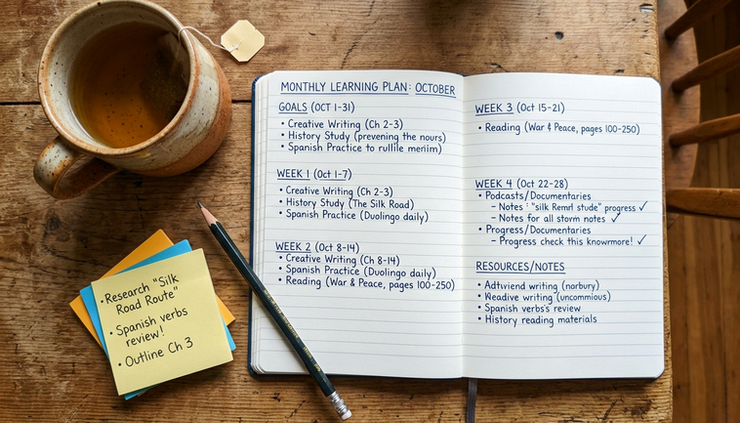
A practical learning plan might include:
One article, report or chapter each week.
One conversation each month with someone skilled in a relevant area.
One small experiment in a real task.
One note about what changed after the experiment.
The record matters. Over time, it becomes a personal learning portfolio. It can support appraisals, interviews, role changes and self-confidence.
Learning also becomes easier when it connects to real goals. “Learn AI” is too broad. “Use an AI tool to summarise customer feedback and then verify the results manually” is specific. “Improve communication” is vague. “Practise writing clearer project updates every Friday” is workable.
Small, specific learning beats large, unclear ambition.
The new career advantage is learning agility
The old career promise was stability through mastery. Learn a field, gain experience and become the expert. That path still exists in some professions, but even experts now need renewal.
The stronger promise is stability through learning agility. A professional who can learn, unlearn and relearn has more options. They can move across roles more easily. They can respond when tools change. They can work with younger colleagues without feeling threatened. They can stay useful without pretending to know everything.
This mindset also makes careers more humane. It allows people to grow at different stages of life. Someone returning after a break can rebuild confidence. Someone in mid-career can shift direction. Someone early in their career can develop depth without rushing to appear like an expert.
The rise of the always learning professional is not just a response to technology. It is a response to a broader truth about work: the world will keep changing, and careers will belong to those who keep paying attention.
The next step does not need to be a major course or a new qualification. It can be one honest question: What do I need to understand better to do my work well in the year ahead?
Answer that, act on it and repeat. That is how learning becomes a career strength.



Comments